Hey y’all,

When you buy chicken at the grocery store, it can be easy to forget about everything that happended before that chicken ever reached the package.

Most of us only see the finished product, neatly packaged and sitting in the meat case.

But take a look at how most of America’s chicken begins.

In large-scale commercial poultry operations, thousands—and sometimes tens of thousands—of chickens can be raised together inside a single poultry house.

Those birds generally spend their entire grow-out period indoors.

They don’t have fresh grass underneath their feet. They don’t scratch around outside looking for bugs. They don’t get natural sunshine on their backs.

And then there’s the ground that they’re living on.

Commercial poultry houses commonly use bedding called litter, often made from materials such as wood shavings. As the chickens grow, manure, feathers, spilled feed and moisture accumulate in that litter.

That means the same floor where the chickens eat, drink, walk, sit and sleep is also where they defecate.

As thousands of birds move around, dried litter, manure, feathers and dander can contribute to airborne dust inside the poultry house. Manure decomposition can also produce ammonia, which is one reason ventilation and litter management are so important in commercial poultry production.

With large numbers of animals living in close proximity, producers also have to pay close attention to disease prevention and biosecurity.

Vaccinations and antibiotics are often necessary to control flock-health concerns.

Now, Let Us Show You How We Raise Ours
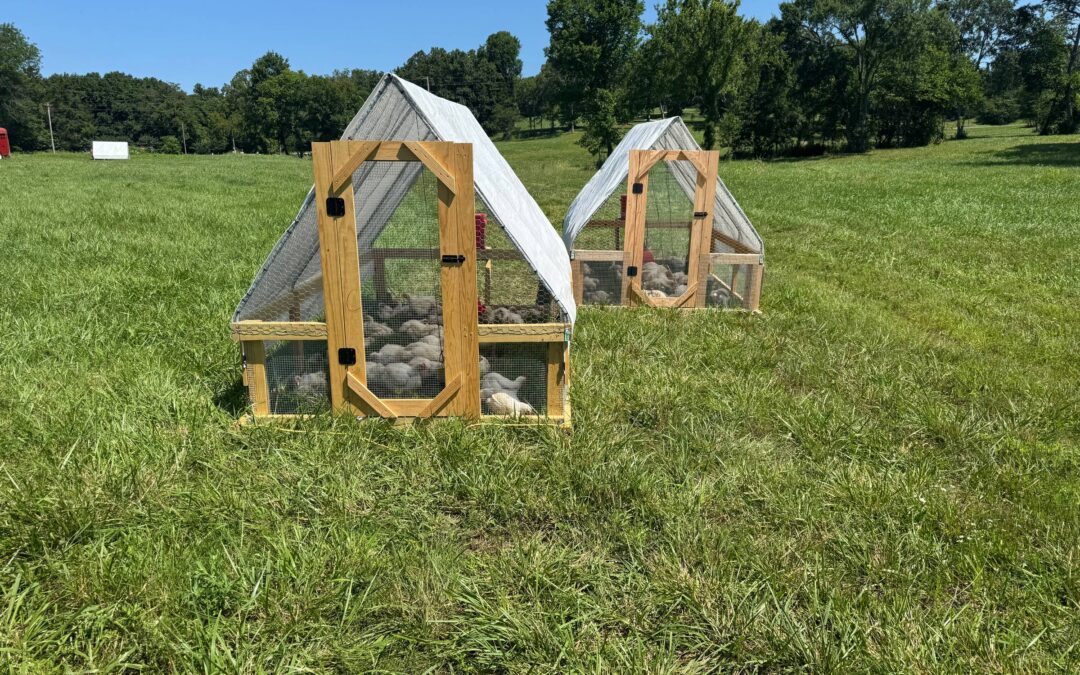
At Forester Family Farm, we raise our chickens in small batches on pasture.

Once they’re old enough to leave the brooder, they head outside where they have:

☀️ Fresh Air & Natural Sunshine — Our chickens spend their days outdoors instead of confined inside a poultry house.

🦗 Access to Natural Forage — They can forage through grass, plants, seeds, bugs, and other things they naturally find on pasture.

🐔 Room to Express Natural Behaviors — They can scratch, peck, forage, move around, and behave like chickens.

🌱 Regular Moves to Fresh Pasture — We move their shelters twice a day, giving them a cleaner environment and preventing them from spending their entire grow-out period on the same manure-covered floor.

🧑‍🌾 Raised in Small Batches — We aren’t managing tens of thousands of birds at once. Raising smaller groups allows us to personally feed, water, move, and check our chickens every day.

Moving the shelters on pasture means our chickens aren’t spending their entire lives standing and eating on thier toilets.

They are never given vaccines or antibiotics because they don’t need it.

Is raising chickens this way the fastest way to produce chicken?

Nope.

Is it the easiest?

Definitely not.

We’re out there moving shelters, hauling feed, checking water and tending to these birds every single day, twice a day.

But we’re also not trying to produce chicken as cheaply or as quickly as possible. We’re trying to raise chicken in a way we’re proud of.

We’re a small family farm here in the Ozarks. The same chicken we sell to our customers is the chicken we put on our own family’s dinner table.

That’s important to us.

And we think folks deserve the opportunity to know where their food came from and how it was raised.

So next time you’re deciding between a package of chicken from the grocery store and chicken from a local farmer, don’t just compare the price tag.

Ask how it was raised.

The pictures tell quite a story.

Thanks for supporting our little family farm and allowing us to keep doing things a little differently.

Veteran-Owned • Family-Operated • Pasture Raised in the Ozarks

With our appreciation,

Billy, Eva, and Family